An Archaeology of Ideas


An Archeology of Ideas
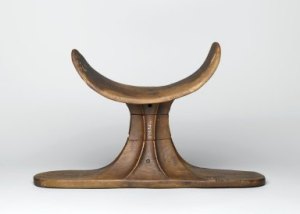
Caption: Headrest with Two Images of the God Bes, ca. 1539-1190 B.C.E. Wood, 7 x 11 1/4 x 3 in. (17.8 x 28.6 x 7.6 cm). Brooklyn Museum, Charles Edwin Wilbour Fund, 37.435E. Creative Commons-BY-NC

Just before Christmas, some friends and I visited the Brooklyn Museum’s “Egyptian Fragments” exhibit.  The one teeny room of stone foots and hands, etc. was underwhelming, but the main Egyptian rooms were fascinating, as always, and small enough that we could pay extended attention to individual pieces.

One display case fascinated me, particularly a small note at the bottom of the case.  It mentioned that the ancient Egyptians believed the sun had three different forms or aspects: the rising sun, the sun at noon, and the setting sun.  This seemed a striking idea, at first, since most of us think of the sun as one interplanetary object at all times, even when we can’t see it at night.  It pleased me, though, as an example of the power of names and words and how they can shape perception.

Apparently, Egyptians associated the rising sun with Khepri, a god linked to the scarab (a dung and carrion beetle).  Since scarabs appeared to the Egyptians to breed from the dung and offal they fed on, the word “khepri,” also means “to come into being.”  Hence, you can see how the Egyptians might have associated it with the rising sun.

Ra-Horakhty is the sun at its zenith, at noon.  It is also the name of a god, combined with an epithet that means something like “Ra (who is) Horus of the Horizons.”  Ra and Horus were two of Egypt’s most revered gods, and Ra was a sun god.  So, to be a Horus as far as the eye could see was to be supreme like the sun at the top of the sky in the middle of the day.  In Egypt, so close to the Equator, the sun really is very close to the center of the sky at noon.  Thus, Ra-Horakhty was the sun at a moment of both spatial and temporal fullness.

The setting sun was represented by another sun god, Atum, who eventually merged with both Ra and Amun to become a sort of tripartite solar divinity.  Atum’s name apparently derives from the word ‘tem’, which means to complete or finish, hence his association with the sun at the day’s end.

Of course, we have the words “dawn,” “morning,” “sunrise,” “noon,” “mid-day,” “sunset,” and “evening” in English.  They convey our sense of three cardinal points in the transit of the sun each day.  But they seem broader and vaguer than the Egyptian terms.  Except for “sunset” and “sunrise,” they don’t refer to the sun directly.  Even these latter two terms convey more about the sun’s position in space and time than something physically or spiritually distinct about the star in each of these moments.  (Of course, the words “morning” and “dawn,” especially, convey an emotional charge in English, too.)

Maybe the Egyptians’ anthropomorphic naming of the sun in its three primary daily manifestations stirred me a little.  It felt poetic and slightly spooky.  It wouldn’t do to make too much of my museum epiphany—or exaggerate the notion that the ancient Egyptians thought of the sun as three truly separate entities at morning, noon, and evening.  Still, I felt I had stumbled across something as antique and foreign as the ibis and crocodile mummies we’d seen in another room, the canopic alabaster jars that held embalmed human organs, or the u-shaped ceramic or wooden “pillows” Egyptians used when they rested or slept.

There can be an archaeology of ideas, in other words, as revelatory as any unearthed tomb in the Valley of the Kings.

Posted in Musings, Prose | Tagged , , , , , , , | Leave a comment

Winterreise


This slideshow requires JavaScript.

Posted in Cahier, Photos | Tagged , , , , , , , | Leave a comment

Against Purity


New Zealand Black Tree Fern (Photo Credit: Wikipedia)

Against Purity

Beware purity wherever you hear it praised, see it flaunted, or find it ascribed to people, actions, institutions, or ideas.

Except as a property of chemicals or colors, it’s one of the most poisonous metaphors known to humankind. Even the teensiest dose can kill you secretly, when you least expect it, or attack you head on, like a soldier with a bayonet.

Purity’s synonyms all end in “ism”: patriotism, nationalism, racism, tribalism, puritanism, fascism, authoritarianism, absolutism, sectarianism, nihilism, etc.

Its proponents are always holier-than-thou, even when they don’t invoke Jesus, Mohammed, Jehovah, Krishna, Gaia, or the Great Spirit. Purity’s avatars are angry and have very large fangs. Like Furies, they blindly seek to segregate, prohibit, fossilize, and destroy.

Celebrate, instead: the pied; the parti-coloured; the mongrel; the hybrid; the half-bred; the smorgasbord; the potluck; the catch-as-catch can; the jury-rigged; the explorer; the new; the spoiled, the tabula rasa, the indelibly tatooed; the previously owned; the peculiar; the average; the stranger; the dirty; the thoroughly scrubbed; the forgery; the original; the isolato; the lover; the slutty; and that spicy, promiscuous joy in everything unknown, misunderstood or overly familiar.

Mix, speciate, intermingle, dilute and intensify. Dig, erect, copulate, emulate, resist and submit.

Worship toadstools, sapphires, once-in-a-blue-moons, your daily routine, orchids, upside-down cakes, New Zealand tree ferns, smiley-faced daisies,
molé sauce, and muddy puddles that reflect the sky.

Wherever you go, stash this spell in your pocket:

A little dirt
never hurt.

Without the dark,
no angel would hark.

A week in the sty
makes you more spry.

After the laughter, comes a kiss
and bliss.

Posted in Opinion, Prose | Tagged , , , , , , , , , , , , | Leave a comment

Bellow’s Letters: Two Quotations


Bellow’s Letters: Two Quotations

Saul Bellow (Photo Credit: Bettmann/Corbis via The New York Times)


“Really,” Bellow writes to Lionel Trilling in 1952, “things are now what they always were, and to be disappointed in them is extremely shallow. We may not be strong enough to live in the present. But to be disappointed in it!”

“A language is a spiritual mansion from which no one can evict us,” and in that palace Bellow was sovereign. “The only sure cure is to write a book,” he advises Alice Adams.

Drawn from Leon Wieseltier’s excellent essay in the November 18, 2010 issue of the Sunday New York Times Book Review.

Posted in Quotations | Leave a comment

Diplomats & Dragons


Diplomats & Dragons

Josef Stalin (Photo Credit: Margaret Bourke-White)

“A sincere diplomat, Stalin once said, “is like dry water or wooden iron.” (from a “Talk of the Town” piece by Lizzie Widdicombe in December 13, 2010 issue of The New Yorker.)

While Stalin’s off-hand characterization of the routine duplicity of diplomacy may be accurate, doesn’t Ms. Widdicombe miss a scaly, fire-breathing, man-eating irony here?

Granted, her charming brief piece focuses on the recent WikiLeaks controversy, exposed U.S. diplomatic cables, and the deceptions all of us practice in daily social life.  Still, quoting Josef Stalin’s moral critique of anyone feels like talons scratching a blackboard. It makes me shudder.

Wasn’t Stalin responsible for 10 to 20 million deaths? (See note.)  Didn’t he sign a pact with Hitler?  Didn’t he deport millions in a process of ethnic cleansing and territorial control?  Didn’t millions more die as the result of the forced collectivization of Soviet farming in the 1930’s?  Isn’t, in fact, the tally of suffering he caused incalculable, untold, unbearable?

The dishonesty of 99.99% of history’s ambassadors must pale beside the roster of Stalin’s deceptions and depredations.  The phrase, “grotesque hyprocrisy,” wouldn’t even begin to cover his remark about diplomats.

Widdicombe seems beyond tone deaf in this instance, more like “See no evil, hear no evil speak no evil”.  Admittedly, it’s a minor gaffe.  Still, would she quote Hitler so casually and without any further qualification?

Expecting a dragon to proffer reliable truths is like… well, you pick the final term of the simile.  Many come to mind.

When Stalin—or any creature of a similar reptilian habit—slithers out for a chat and a meal, I’d suggest you run for your life or brandish a very big, very keen sword.

Posted in Musings, Prose | Tagged , , , , , , , , , | Leave a comment